Tiny Chinese Microchips Reportedly Found Hidden in Amazon, Apple Servers
The jaw-dropping report is disputed by some of the supposed victims.
By Eric Limer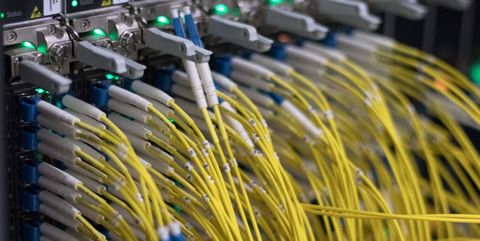
GERMANY-ECONOMY-TECHNOLOGY-ITGETTY IMAGESYANN SCHREIBER
Chinese-made microchips roughly the size of the tip of a pencil have been found hidden inside servers used by Apple, Amazon, and government contractors according to a report by Bloomberg Businessweek. The origin of the chips reportedly traces back to a U.S.-based company called Super Micro Computer Inc., which works with subcontractors with manufacturing facilities in China, where the tiny eavesdropping chips were inserted.
According to Bloomberg, the chips were discovered by Amazon's Web Services division in 2015 during the due diligence prior to the acquisition of a video streaming company called Elemental Technologies, whose servers were assembled by Super Micro. The discovery then sparked a years-long investigation by the U.S. government that is still open to this day. While Amazon discovered the chips, it was not the only company affected. According to Bloomberg:
One official says investigators found that it eventually affected almost 30 companies, including a major bank, government contractors, and the world’s most valuable company, Apple Inc. Apple was an important Supermicro customer and had planned to order more than 30,000 of its servers in two years for a new global network of data centers. Three senior insiders at Apple say that in the summer of 2015, it, too, found malicious chips on Supermicro motherboards. Apple severed ties with Supermicro the following year, for what it described as unrelated reasons.
The named companies, for their part, are disputing Bloomberg's reporting, with Amazon insisting it knew nothing of secret chips when it ultimately acquired Elemental Technologies, and Apple claiming never to have discovered any malicious chips. Bloomberg, meanwhile, cites numerous national security officials and Amazon insiders as its sources.
The magnitude of this discovery is significant for multiple reasons, first and foremost is the level of access a hardware hack like this can provide, and the difficulty in fixing it. The chips, so small and camouflaged as to be effectively invisible to the untrained eye even during X-ray examination of the infected boards, were able to manipulate code as it traveled to its host server's CPU and also communicated with remote, anonymous servers that could give it complex instructions by hijacking components designed to give administrators remote, high-level controls of malfunctioning units.
This power gives the chips practically unlimited control, as Bloomberg notes:
Somewhere in the Linux operating system, which runs in many servers, is code that authorizes a user by verifying a typed password against a stored encrypted one. An implanted chip can alter part of that code so the server won’t check for a password—and presto! A secure machine is open to any and all users. A chip can also steal encryption keys for secure communications, block security updates that would neutralize the attack, and open up new pathways to the internet. Should some anomaly be noticed, it would likely be cast as an unexplained oddity.
In addition to the severity of the danger, the breach is impressive for its logistical complexity, requiring top secret coordination between a Chinese military unit and factories were the chips could be installed.
Bloomberg reports that Amazon has moved Elemental Technologies' software over onto its own Amazon Web Services hardware and that Apple has removed servers made by Super Micro from its data centers. Officials have reportedly reached out to other select Super Micro customers privately to take similar action.
Source: Bloomberg
No comments:
Post a Comment