Zuckerberg himself famously taped over his camera, but should you also watch what you say around your mic?
Spend enough time on the internet and you’ll eventually see ads targeted specifically to you. Facebook is no different. Watch a trailer for Justice League and you’ll start seeing ads for comic books or other superhero movies. Many of you likely didn’t realize it was happening for some time after it started. It’s a system we’ve basically accepted as part of our daily lives, but some people are now theorizing that Facebook might be using a computer’s microphone to mine your conversations for ads.
The BBC reports that PJ Vogt, who presents a tech podcast called Reply All, sent out a tweet calling for people’s stories regarding why they believe Facebook may be listening in on their conversations for the purposes of ad targeting.
Rob Goldman, Facebook’s VP of ads, chimed in to reassure people that Facebook does not use people’s mics as a way of spying on them.
Despite the many responses that Vogt received, there isn’t much, if any, concrete proof that Facebook uses people’s mics to spy on them.
As for why Vogt’s Tweet got so much attention, one explanation is that it is simply a matter of coincidence. The ads might have been there the entire time and people simply didn’t notice them at first.
Facebook isn’t the only company to come under fire for this issue. Many people believe that smartphones are being used by companies as a means of collecting information on consumers.
Media captionBarcelona rally demonstrator: 'I feel forgotten by Catalan government'
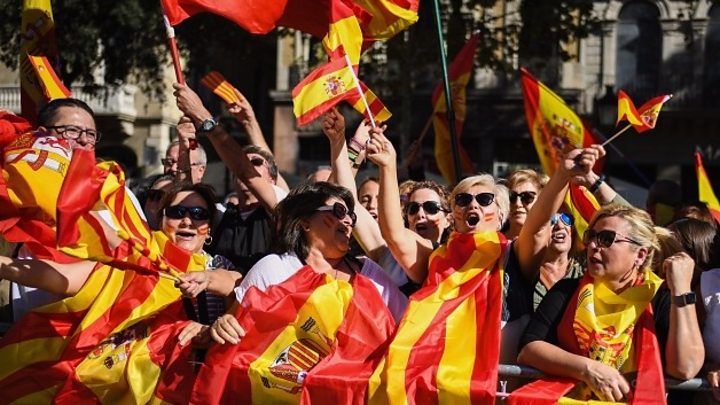
Hundreds of thousands have attended a rally for Spanish unity in Barcelona after Catalonia was stripped of its autonomy for declaring independence.
Many urged the jailing of sacked Catalan leader Carles Puigdemont.
Mr Puigdemont was dismissed as Spain's central government took control of Catalan institutions.
Spain's foreign minister has said that he could run for re-election in December - if he has not been imprisoned by then.
Alfonso Dastis's comments come as Spain's chief prosecutor prepares to file criminal charges against the pro-independence leader, who has said he does not recognise the order from Madrid removing him from power.
Meanwhile, in an open letter, Interior Minister Juan Ignacio Zoido has urged the Catalan regional police force to accept temporary direction from Madrid.
Spain has been gripped by a constitutional crisis since a referendum, organised by Mr Puigdemont's separatist government, was held earlier this month in defiance of a ruling by the Constitutional Court which had declared it illegal.
The Catalan government said that of the 43% of potential voters who took part, 90% were in favour of independence.
Police said at least 300,000 people had turned out in Barcelona, Catalonia's largest city, for the pro-unity rally. Organisers and the government in Madrid put the turnout at more than a million people.
'I am Catalan too'
Veteran Catalan politician Josep Borrell, a former president of the European Parliament, told demonstrators: "Mr Puigdemont may speak on behalf of some of the Catalan people, but I am also Catalan, I am also part of the Catalan people, and I do not recognise his right to speak in my name."
Among the demonstrators was Marina Fernandez, a 19-year-old student, who said she was unhappy with the actions taken by the Catalan authorities.
"I am enraged about what they are doing to the country that my grandparents built," she told the AFP news agency.
Another protester, Maria Lopez, told Reuters news agency: "What do we want? That they don't break us up. They are shameless, shameless, and Mr Puigdemont needs to be taken to prison."
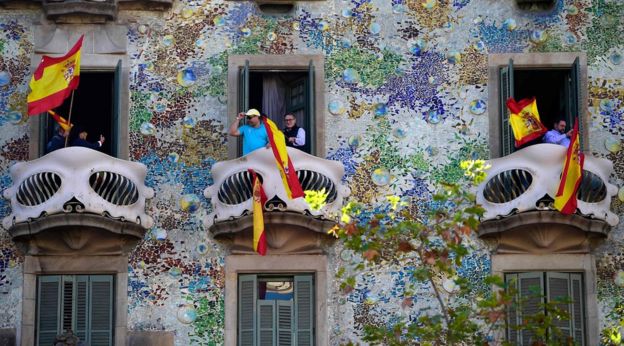
Image copyrightAFP/GETTY IMAGESImage captionPro-Spain protesters gathered at the Gaudi-designed Casa Batllo in Barcelona
The deputy president of the deposed Catalan government, Oriol Junqueras, has condemned Madrid's actions.
"The president of the country is and will remain Carles Puigdemont," he wrote in Catalan newspaper El Punt Avui.
"We cannot recognise the coup d'etat against Catalonia, nor any of the anti-democratic decisions that the PP [Spain's ruling Popular Party] is adopting by remote control from Madrid."
'Silenced majority'
By Gavin Lee, BBC News, Barcelona
Many of them waved Spanish flags and chanted "Viva Espana" and "The streets are for everyone" as they marched through Barcelona in support of Spanish unity and against Catalonia's unilateral declaration of independence.
Catalonia's main opposition party said the region's "silenced majority" was now speaking.
The atmosphere was peaceful, as police helicopters monitored from above.
Several off-duty police officers who had joined the protest told the BBC they felt there was deep division in their ranks, and were worried what could come next if their separatist colleagues refused to take orders from Madrid.
The key issue is what happens to Carles Puigdemont, who is still calling himself the Catalan president - despite having been removed from office by the Spanish government, along with his cabinet and more than 100 officials.
His job, in all but title, has been transferred to Spain's deputy prime minister until elections in December.
Independence supporters are being urged to resist any attempt by Madrid to forcefully remove the separatist leaders.
Friday saw the regional parliament declare independence, with Madrid responding by declaring the move illegal.
Prime Minister Mariano Rajoy then announced the dissolution of the regional parliament and the removal of Mr Puigdemont as Catalan leader, and ordered that fresh elections should be held on 21 December.
Mr Puigdemont has urged "democratic opposition" to direct rule from Madrid, which has said it would welcome his participation in the election.
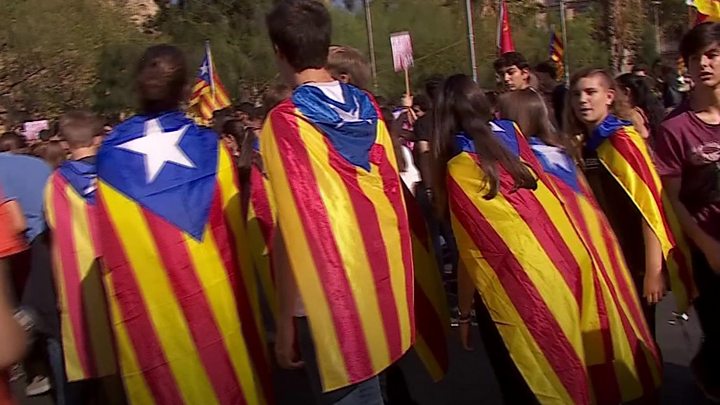
Media captionFlags in Catalonia and what they mean
On Sunday, Belgium's Migration Minister Theo Francken told local TV the separatist leader could be given asylum protection which Spain would find difficult to reverse.
"If you see the situation at the moment, the prison sentences and the repression from Madrid and the prison sentences that are bandied about... the question is obviously whether somebody like that has the chance of a fair trial," he told Reuters.
There is no suggestion that Mr Puigdemont is seeking to leave Catalonia.
He had been expected to attend a football match in Girona, the heartland of the pro-independence movement, which saw the local team beat Real Madrid - who Mr Rajoy supports - by 2-1. But he apparently did not make an appearance.
A poll published by Spanish national newspaper El Pais on Saturday suggested a small majority of Catalans (52% to 43%) were in favour of the dissolution of the regional parliament and the holding of elections.
Fifty-five per cent of Catalan respondents opposed the declaration of independence, with 41% in favour.
Before Madrid took over the Catalan government, the region had one of the greatest levels of self-government in Spain.
It has its own parliament, police force and public broadcaster, as well as a government and president, though those have now been dismissed.
Basic Economy Is a Success for Airlines, Even If Travelers Don't Buy the Tickets
Getty Images
CAILEY RIZZO
Airlines are unlikely to get rid of basic economy fares any time soon. And they don’t even care if nobody buys the no-frills tickets.
Basic economy is “more of a defensive product than it is an offensive product, because we need to have a product for people who are just price conscious,” Delta Air Lines president Glen Hauenstein told reporters last week, according to Air Transport World. “Our sell-up [from basic economy] continues to remain high and I think that’s the key part.”
In other words: traditional airlines only created basic economy as an option for people who generally fly on budget airlines. It was never meant to provide a price break for its average customer base. In fact, airlines gauge their success on how many people choose not to buy basic economy tickets.
The trend has only continued to grow over the past few years. Delta was the first legacy airline to offer this airfare category, introducing basic economy back in 2015. And in February of this year, United and American Airlines jumped onboard.
Even if, as a collective flying society, travelers decided never again to buy a basic economy ticket, airlines would be unlikely to eliminate the option.
Airlines make billions off the tricky venture (possibly $3.1 billion by next year). In addition to retaining customers who would have otherwise been poached by budget carriers, airlines often profit from travelers who don't fully understand the limitations of a basic economy ticket. Hauenstein noted that these customers often end up paying more to upgrade their trip (fees for checked baggage, for food, and for seat selections, among others).
The best defense against overpaying for lower class service is to read up on the specific policies for individual airlines. Those traveling with extra luggage will likely find that a general economy ticket is the cheaper option.